Projects Code
FDE Research
Nine agent skills behind one entry point that turn a vague enterprise AI request into a project plan you can defend: evidence first, human sign-off last.
- When
- May 2026 – Oct 2026
- My role
- Author and maintainer
- Built with
- Agent Skills, Claude Code, Python, Markdown
- Status
- Public on GitHub. All rights reserved; no open-source license is granted.
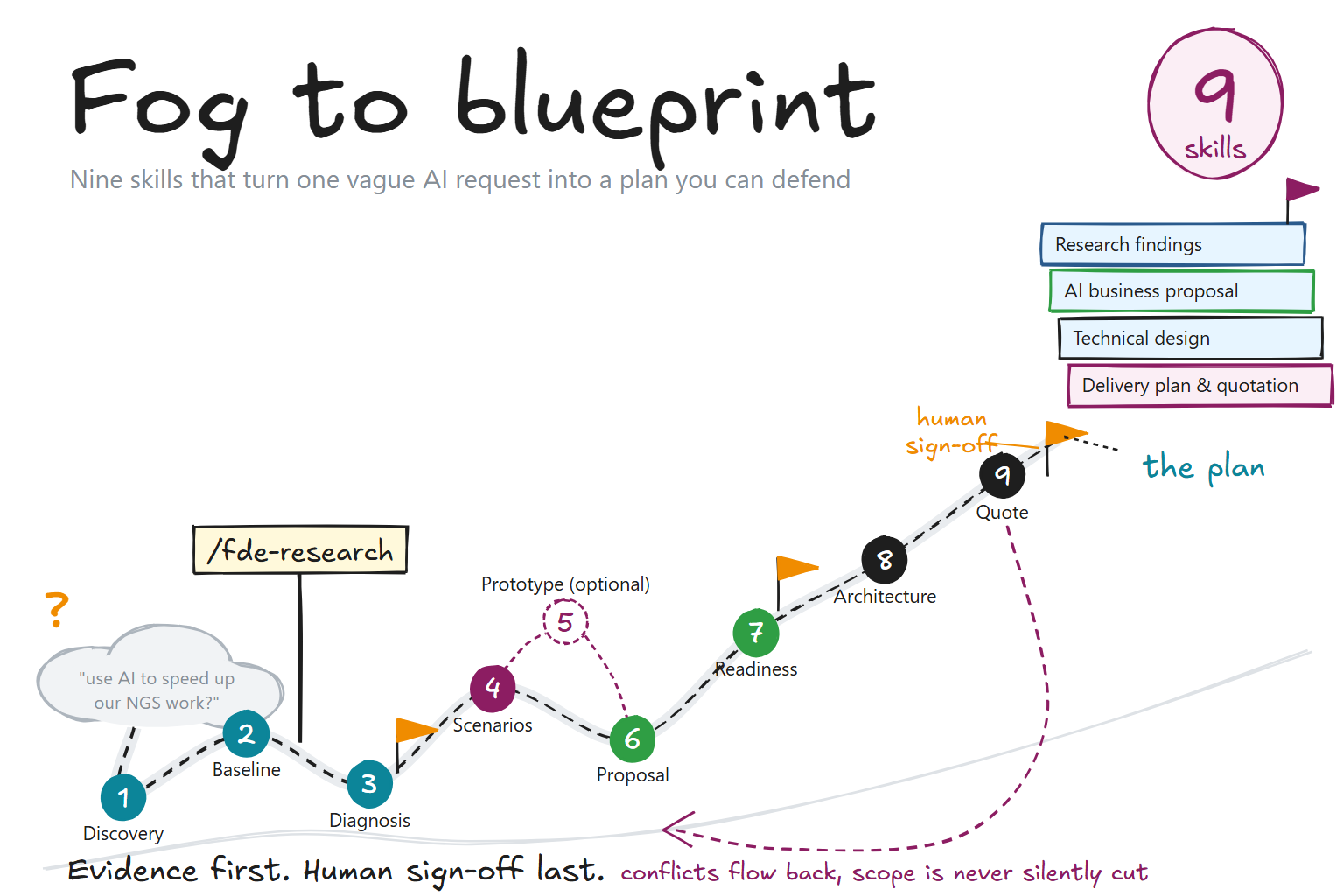
- 9 specialist skills behind one /fde-research entry
- 4 deliverables: findings, proposal, technical design, delivery plan and quotation
- Human the agent drafts and checks; a person signs off
Project introduction
Why
Most enterprise AI projects start as one vague sentence, something like “use AI to speed up our NGS work”. The expensive mistakes come next: a proposal built on a baseline nobody measured, a design that assumes data nobody has seen, a quote that quietly drops scope. I wanted a way to go from that sentence to a plan a business, a technical team and a finance lead can all review, without inventing numbers along the way.
What it is
A package of nine agent skills for the period before implementation, plus one routing entry, /fde-research, that works out where a project stands and resumes from there. The entry is a router, not a tenth stage.
- Investigate. Discovery, baseline analysis and business diagnosis turn interviews, documents and process data into a scoped current state, a computed baseline and candidate opportunities.
- Define and show. AI scenario design writes before-and-after scenarios; an optional prototype makes the best one tangible.
- Align and check. A business proposal sets the scope and responsibilities, and an implementation-readiness check tests it against six dimensions of real conditions.
- Design and quote. Technical architecture produces the design and diagrams, and delivery planning produces the schedule, acceptance criteria and quotation.
Used end to end, it yields research findings, an AI business proposal, a technical design and a delivery plan with quotation.
Design choices
- Evidence first. Every number traces back to its source, and a gap stays “not measured” rather than being filled with a plausible guess.
- Humans sign off. The agent drafts and checks. Generated, verified and business-confirmed are kept as separate states, and only a person confirms.
- Conflicts flow back. If time or budget clash with scope, the affected proposal or design is revisited. Scope is never silently reduced.
- Use one skill or the full chain. Each skill accepts equivalent inputs, so you can run just the baseline analysis or just the quotation, and one project’s materials never leak into the package.